Tuesday, September 22, 2026

THOUGHTFORMS- What are they really?....


During the Summer of 2026 I got an email from Morbid Anatomy librarian requesting writings on thought forms and other esoteric ideas. This is my response:

 THOUGHTFORMS
 
A thoughtform is a “mental construct generated by focused thought, emotion, or imagination. Depending on the context, it refers either to the psychological visualization of an idea or to an intentionally crafted, semi-autonomous psychic entity.”

In many esoteric traditions, including Theosophy, sustained and emotionally charged thoughts are believed to manifest as tangible energy patterns on the astral or mental planes. Psychologists and secular philosophers, by contrast, interpret thoughtforms as powerful cognitive patterns or externalizations of inner dynamics. A person's persistent habits, self-image, or even internalized concepts—such as a brand, ideology, or movement—can be understood as living thoughtforms that shape behavior and reality.
 
During the height of the New Age movement, I came across a book titled *Thoughtforms*. I bought it and am certain I still own it. Yet despite searching my library repeatedly, I have been unable to find it. I resorted to visualization techniques—nothing. I called upon my elves, those unseen forces of nature and ancestral spirits that, for me, symbolize a bridge between the physical world and the spiritual realm. They embody harmony, higher consciousness, and the untamed magic of the cosmos. This time, however, their response was silence.
 
So I turned to Google before entering my own memory library in search of thoughtform files. There I encountered the two definitions that most interested me: the occult and the psychological.
 
As a clinician, I am trained to observe cognitive patterns and the ways they are externalized, shaping behavior and reality. In clinical language, we often call this projection. Yet nothing has brought me more directly into contact with the intersection of the psychological and the esoteric definitions of thoughtforms than my work with members of the African community.
 
Many sessions involved entering a reality in which spirit and daily life coexisted seamlessly. Conversations frequently centered on what clients saw around them—or even what they saw in my consulting room. Understanding these experiences required an aerobic exercise of both intellect and spirit. My clinical training provided one framework; my personal experiences offered another. Often, it demanded intellectual acrobatics to explain to other providers that a person was not psychotic but rather speaking from within a cultural and spiritual reality that differed from their own.
 
At around the same time, I repeatedly saw my father sitting quietly in a corner of my consulting room, observing me as I worked. On those occasions when I was alone, I spoke to him.
 
Once I asked why he had come.
“I just wanted to see what you do. Now I understand.”
 
My father died in 1991.
 
Continuing with my father and moving into more personal spiritual territory, I recall an experience that occurred shortly after his death. Several days after his crossing, I went for an Ifá reading, a traditional Yoruba divination practice used to seek guidance, understand one's destiny, and navigate life's challenges. During the reading, I was advised to prepare a ritual table to assist him in his journey.
 
When I returned home, I followed the instructions.
 
That night I was awakened by a strange sound coming from the ceiling above my bed. Looking upward, I saw my father's hands reaching toward me. My immediate impression was that he did not realize he had crossed into the spiritual realm. I sensed confusion and struggle in his energy. I began speaking to him, attempting to comfort and orient him.


Was that a thoughtform? …
 
Experiences such as these have occurred throughout my life. Most happen at home, ranging from apparitions to sounds and kinetic sensations. Friends who have crossed over sometimes seem to return for a visit. I see them and converse with them. The conversations often revolve around what I am doing, my curiosity about how they are faring, and whether they are content where they are now.
 
There are also moments of intense meditation upon someone—moments in which my concentration becomes so focused that the person appears vividly before me. Simply seeing them brings comfort and satisfaction.
 
Four years ago, I was hospitalized overnight for observation after experiencing chest pain. In the middle of the night, I awoke to find two large beings standing beside my bed, one on each side. They were dressed in long, radiant white garments.
 
“Do not worry,” they said. “It is nothing. We are here.”
 
Their reassurance soothed me, and I fell back asleep.
The following afternoon I was discharged. The diagnosis, essentially, was that it was nothing to worry about.
 
These mystical experiences enrich and inform my artistic practice. Sometimes an image appears in a dream and follows me throughout the day until I bring it to life on paper or canvas. Other times, a drawing dormant in one of my sketchbooks begins to announce itself. I start seeing elements of it everywhere, as though the image is insisting upon its own birth. Then I know it wants to be brought into the world.
 
The noises I hear in my apartment—knocks on a table, the clatter of silverware in the kitchen, the sound of a utensil falling onto a counter for no apparent reason—I often interpret as signs of a presence seeking contact. I always want to understand the message, though I rarely succeed.
 
There was a period when these sounds occurred almost nightly as I prepared for sleep. In response, I would leave a piece of paper, a pencil, and a bowl of water nearby, inviting the visitor to leave me a note.
 
Nothing ever appeared.
 
And now, as I write this piece, three of the five ceiling lights in my office are flickering.
 
If I say, “Hello. How can I help you?” the flickering stops.
 
Ghosts?… Thoughtforms? …
 
Or perhaps lingering elves, leaping from one light to the next? ...

Thursday, October 30, 2025


THE PIPER OF DREAMS, 1915 by
Estella Canziani


Nothing like fairy tales to take us into an imaginary world where we can escape to obtain solace in times of stress and unrest. This might be the reason of my attraction to this painting when as we- globally- are experiencing the uncertainty that social political disturbances is creating.

We know about Cinderella, Sleeping Beauty, Little Red Riding Hood, all stories that are full of magic, wicked characters, love stories, and the triumph of good over evil. It has captivated our imagination for centuries. But the original versions fo these popular fairy tales were much darker in nature. Originating in European folk stories, designed, very often, to be parables with a moral twist, featuring painful punishments, sadistic parents and children being devoured by wild animals- no the kind of bedtime stories... 

Within that context. fairy painting unfolded as escapism for Victorian adults, mostly in the UK. But now... let focus on 'The piper of Dreams' 1915 fairy painting.

Canziani (188-1964) was born in London, a painter who worked as a book illustrator and wrote articles in Folklore, the journal of the Folklore Society. She was the daughter of painter Louisa Starr, who herself produced 'fantasy' paintings. Canziani lived her whole life in the same house but travelled broadly publishing few travel books based on her trips. 

I became aquatinted with her work when reading The Other Book- a Story of Women in Art and the Spirit World by Jennifer Higgie (2024). Higgie elavorates on the intense challenges artists, like Canziani, faced during WWI and on the role that fairy painting occupied during those days.

During WWI (1914-1918), fairy painting resurged as a way to escape the horrors of the war and as a symbol of hope for a society dealing with the trauma of war. It is understandable that Canziani fairy painting 'The piper of Dreams' - originally titled 'Where the little things of the wood live unseen' became very popular at the time- it sold on the opening day of the Royal Academy exhibition and hundreds of thousands of copies of the picture were sold the next few years and posted to troops across the world (britishfairies.wordpress.com)- it provided some form of belief and a bright spot in a world in crisis with so much uncertainty.

Higgie explains about the painting "gently posits a psychic space that was desperately needed in 1915. It's a safe image ... The piper is the face of socially acceptable escapism- hope visualized as a woodland populated by mystical beings, nature a place of refuge and consolation..."

So... fairy painting like 'The piper of Dreams' provides a path to escape into a world of our imagination. What provides you with the necessary escapism from current stress and unrest?...  Would love to ready your thoughts in the comments section below.


Wednesday, October 22, 2025


@ The Museum of the Art Institute of Chicago I just saw a terrific exhibit on symbolism. As a symbolist artist myself, to view the exhibit brought pleasurable enjoyment. 

A display of about 80 works on paper drawn from the Art Institute of Chicago's collection of drawings, prints, and illustrated books that captures Symbolism's diverse styles and imaginative mysterious worlds.
The Symbolism began in 1880s in France as a literary and very quickly was embraced by visual artists who shared a "cynical perspective on technological advancement and the influx of people from rural areas to urban centers across turn-of-the-century Europe...". 

For them the rise of industry and materialism was a sign of moral decline, although they "embraced scientific discoveries as fertile ground for inspiration..."
Symbolist used art to imagine alternate realities, some transposing mythological and religious subjects  while others turned inward to examine the self.

The exhibit runs from October 4, 2025- January 5, 2026
For more information on the exhibit 


Here there are some pics of the exhibit. I hope you enjoy them. Would love to read your thoughts in the comments section below!


 Odilon Redon (1840-1916)


 MaxKlinger (1857-1920)


 Emilie Mediz-Pelikan (1861-1908)


 Gustf Fjestad (1868-1948)


 Frantisek Kupka (1871-1957)


 Henri de Groux (1867-1930)


   Fran von Stuck (1863-1928)


  James Ensor (1860-1949)


  James Ensor (1860-1949)


 Gustav Adolf Mossa (1883-1971)


 Kathie Kollwitz (1867-1945)


 George Minne (1866-1941)


 (George Dorignac (1879-1925)


 Jan Toorop (1858-1928)


 Hans Thoma (1819-1924)


 Jean Delville (1867-1953)


 Edward Munch (1863-1944)


 Edward Munch (1863-1944)


 Max Klinger (1857-1920)


Thursday, October 9, 2025

 JAPANESE ARTIST MARI KATAYAMA USES SELF PORTRAITS TO MAKES US REFLECT ON MISCONCEPTIONS ABOUT OUR PHYSICAL BODIES

    @ the Tate Modern "I'm wearing little high heels, I have child's feet 1992-2023" Japanese artist Mari Katayama uses her body and materials she finds around her to make self-portraits to comfort the viewer confronting misconceptions about our physical bodies. Katayama was born with a rare developmental condition:congenital tibial hemimelia where a child is born with a partial or complete absence of the tibia (shinbone), leading to leg length discrepancies and potential knee and ankle deformities. Katayama chose to have her legs amputated at age 9.

    The exhibit is powerful visually and not totally pleasant to view- it really makes you reflect on your own physical body & spiritual-emotional resilience as well as on the powerful effect of art on the human spirit.


Saturday, November 3, 2018

"THINGS ARE NOT ALWAYS WHAT THEY SEEM..."

Yesterday night I stopped by Carl Hammer Gallery, here in Chicago (http://www.carlhammergallery.com) 

and instead of viewing the show they are presenting at the street level, I decided to go upstairs first. I am super glad to have done that first! where I saw the work of Vanessa German. What an inspiration and delight to see her work!


What I read of her in the American Visionary Art Museum is that she is an "award-winning multidisciplinary artist based in the Homewood community of Pittsburg, PA..." Her sculptures includes statues of female figures with their heads/ faces painted and with a wide range of objects attached to them as you can see on the images above.

The sculptures demand your attention; they demand and command to the viewer to enter into a dialogue with them; their simple standing there in front of them pulls you into searching for the meaning of the many objects attached to it as it allows for an story to unfold- a story that can be your story or the story of someone you know or universal story

I encourage you to go to the gallery's website and view each and on of her works if you can't make it to the gallery.

I must see exhibit! if you ask me ...

Sunday, October 28, 2018

BRIDGES over OBSTACLES


I am back people!

It has been almost one year since I posted on the blog! Que locura!! So many platforms to attend that it was not until I decided to update my website, that it was brought to my attention that I have forgotten my blog!!

I will begin by sharing that I updated my website. It has a more organized way of viewing my different series; it has the six latest paintings from the current solo show Bridges over
Obstacles @ Oliva Gallery in Chicago, and something totally new is a video that Robert Lynch, my webmaster, did on my work. I was thrilled when I saw it as I realized he had been able to grab the essence of my work and woven it with music.

And if going to my web site is not your thing ... here is the link to it: https://youtu.be/-AkAdeOtKA0

May be you like it ... or may be you don't... If have a moment and curiosity, take a look and send me a comment.

Oliva Gallery is located in the Logan Square neighborhood. Follow the link to the gallery here: http://www.olivagallery.com

The next exhibit is a solo show of my partner Jon Randolph with opening date on November 9th, 2018. If you are in Chicago, this show is a must!


Monday, November 27, 2017

Art That Takes Your Breath Away- The Work of EMERY BLAGDON

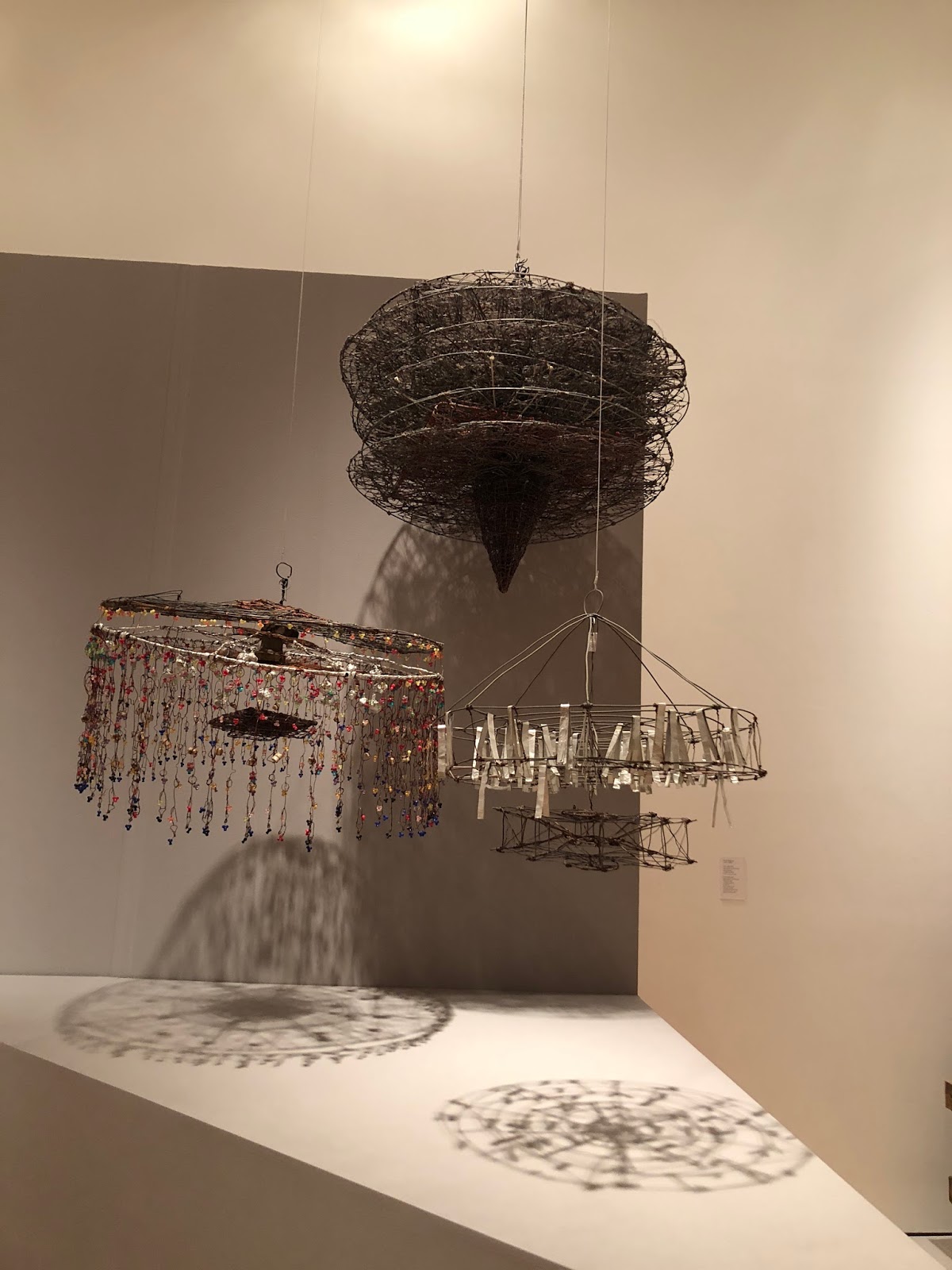
The first time I saw the work of Nebraska born Emery Blagdon (1907-1986) was at the Kohler Arts Center in 2016. I was mesmerized by his work from the first time I encountered it. Entering into the art gallery that holds all his work was an energetic experience where my physical eyes met my soul eyes creating a complete visual and kinetic experience.

Emery Blagdon spent his life building a "healing machine". His immediate family has died of cancer and he knew by direct experience, how illness and suffering build human helplessness. So, he was a firm believer that energy made people feel better and that was what he wanted to do with his work.
"The Healing Machine" was designed to channel the earth's energies to alleviate pain and illness; it was that belief that prompted him to eagerly explore the curative potential of electricity.


You will find a nice PBS video on his life here:

Tuesday, November 21, 2017

OUTSIDER ARTIST: LOY BOWLIN

I was at the John Michael Kholer Arts Center this past weekend (Sheboygan, WI) and, like always, my eyes were treated to one of the best exhibits of outsider art. One of the exhibits was "The Making of a Dream"

This is one of fifteen exhibitions on view throughout 2017 as part of the Kholer Arts Center fiftieth anniversary series, THE ROAD LESS TRAVELED.
"The Making of a Dream" is an exhibit on the work of outsider artist LOY BOWLIN (1909-1995), also known as The Original Rhinestone Cowboy from McComb, Mississippi. He earned that nickname due to him bejeweling his clothing, Cadillac, home and even his dentures with thousands of rhinestones. After his death, his home, the Beautiful Holy Jewel Home of the Original Rhinestone Cowboy, was acquired by the Kohler Foundation, Inc, and was moved to the Kohler Arts Center in Sheboygan, Wisconsin, where it is on permanent display.

His work is mesmerizing. One is transported to high levels of spiritual energy manifested through the colorful glitter that accompany every piece of his work and his entire home.

Here are some photos from the permanent exhibit:


Sunday, November 12, 2017

ON GRATITUDE

In the past six years or so, I came to meet a group of people, of White race, that demonstrate difficulties in saying "thank you". I have pondered about this topic since then and wondered if their inability? unwillingness? to say thank you to me when I extend myself to them in kindness, is because I am immigrant (micro-aggression perhaps...?) or because their monetary wealth makes them believe that they are above others, or just because they feel entitled to receive gratitude but not to give it, fostering the illusion of being some sort of king or queen of an unknown kingdom ...

Some of them seem to have a "chip upon their shoulders" or, like we say in Spanish "caminan como oliendo mierda" (walk like smelling shit). These people are the same that are quick to point out if you don't thank them... hmmm....


So I wonder... where and how do they get this kind of "ego disease"?...


Then, there are the others that on top of never expressing gratitude to me (micro-agrression perhaps...?), they never seem to be curious about the other/me, only if the other happens to be a man, a friend of long time, or be white... hmmm.... I am an immigrant from the South of the American continent.

So I also wonder... where their curiosity of the other is?... could it be that they do not know how to inquiry on the life of an immigrant? or simply is related to be so self-absorbed that having to extend themselves to the other is too much trouble?...


I mostly feel pity for them. I wonder on what negative web of life they got caught?...

Contributing negativity to the world in this way... hmm....don't we have enough of it already?...

With the eye of a clinician, I am able to see beyond the appearance of "ego strength", and I read the behavior as a sign of emotional immaturity, insecurity, low self esteem, low self confidence; and with that, entitlement and narcissism unfold too.


But what is gratitude after all?... I read in the online dictionary that gratitude is "the quality of being thankful; readiness to show appreciation for and to return kindness"


The Positive Psychology Program website opens its article on gratitude with words from USA essayist, lecturer, poet, and leader of the transcendentalist movement of the 19th century Ralph Waldo Emerson:


"Cultivate the habit of being grateful for every good think that comes to you, and to give thanks continuously. And because all things have contributed to your advancement, you should include all things in your gratitude"

The Harvard Medical School defines gratitude this way:
"a thankful appreciation for what an individual receives, whether tangible or intangible. With gratitude, people acknowledge the goodness in their lives... As a result, gratitude also helps people connect to something larger than themselves as individuals -whether to other people, nature, or a higher power"
https://positivepsychologyprogram.com/gratitude-appreciation/

And this topic of gratitude also is bubbling in the veins of USA lately, specially since the 45th took the Oval Office... The USA negative, ungrateful stand against immigrants does not contribute to make this country "great" or even "America first" but discloses a layer of spiritual ugliness that, in my opinion, does not allow a person or a country to be "first or great". USA, a country built upon the labor of immigrants! must being grateful to immigrants indeed!

Expressing gratitude is not only for the other but for oneself. It comes from the recognition of the goodness in our lives and the impact that others have had upon our lives. "...By this process, we recognize everything and everyone that makes us who we are..."

So... NorthAmerica first?.... Of course! Let's begin by expressing gratitude, daily, to the immigrant for what we contribute to this society, and to express gratitude to those around us daily for their kindness, even when that is only a smile or a Hello!

Your contribution in the way of comment/feedback on this topic will be much appreciated. 
Thank you for reading.


Sunday, October 29, 2017

THE PAINTINGS OF M.F.HUSAIN

The exhibition Indian Modern: The Paintings of M. F. Husain has been in view at the Museum of the Art Institute of Chicago since July 2017; and it will continue till March 2017. This is the first time these last works of Husain have been on view in the United States.

The exhibition presents eight large triptychs from the Indian's Civilization series, created by Husain. The work was commissioned in 2008 to celebrate the diverse and rich history of India. Husain intended to created 32 triptychs, but he only completed eight at the time of his death in 2011.

 The exhibit's catalogue informs us that M.F.Husain "was Indian's most important 20th century artist as well as an important figure in the development of modern Indian art".
He was caught between being faithful to traditional Indian art and moving into modern art. The use of strong, vibrant, and bold colors are a sign of modernism, and for that he was criticized.

The exhibit it worth to view. It will at the Museum till March 8th, 2018.


Monday, October 23, 2017

CAPTURING THE DEPRESSION ERA IN BLACK & WHITE

Transportation for Hepcats. 1940

Two of Unemployed Migrant Pickers' Children...1940
Look at this photos! This is the work of Marion Post Wolcott (1910-1990). She was a NorthAmerican photographer who worked for the Farm Security Administration during the Great Depression. She documented the poverty and deprivation people experienced during those days.

I guess to look at these photos help me to focus on the potential of human existence and the potential to overcome adversity.

In the current toxic and unprecedented social and political environment we live in, it is important to remember how resilient our human spirit is and how strong we, as a whole are, to bring positive change in the face of adversity.

Question to you: what keeps you going these days?....

Monday, October 16, 2017

Star Collision

I read this morning on CNN that two neutron stars "in a nearby galaxy have been observed engaging in a spiral death dance..." According to the video this is an "unprecedented discovery" that will take us into a "new era of astronomy" (http://www.cnn.com/2017/10/16/world/neutron-star-collision-gravitational-waves-light/index.html)


I don't know if I really grasp the idea of a "new era" in the astronomy field, but reading about it and seeing the image of these two stars' collision brought to mind a mandala drawing I made back in the early 90s, that I titled:
"Strong Energies Coming Together"

The similarities between the star collision and my mandala are in that, both are expression of intense, strong energies forming a mandala shape.

We have seen this circular shape (mandala) in art and religion since ancient times to the present. Mandala has been a symbol of wholeness, integration of energies, and meditation.
In Sanskrit, mandala means circle and center. Traditionally, the circle has been a symbol of the cosmos.

So, when reading about this collision of the stars, I do think of two strong energies becoming integrated into one and in doing so, it seems they create a new cosmos.

Isn't that what happens in our own process of growth, development, and self-knowledge?...